Showing posts with label Philippines. Show all posts

Tuesday, September 15, 2020

Entertainment: 9 Tips for Gamers to Save Money in the New Normal


We may be living in the new normal, but some things never change: gaming can be an expensive hobby.

As of the writing of this blog post, Sony's PlayStation 4 is selling at a retail price of $299.99 (17,700Php in the Philippines). The Nintendo Switch also costs $299.99 and so does Microsoft's Xbox One S at $299.00. The price of a gaming PC varies depending on the specs but they usually cost much more than consoles.

Whatever your hardware is, getting into video games now is going to put a $300 dent in your wallet. If you're not careful, buying the video games for your platform is going to exacerbate that dent.

Thanks to the coronavirus pandemic forcing people to stay indoors, gaming is quickly turning into a recreational activity that more and more people are getting into. Some time around April, the World Health Organization recommended video games as a pastime to stop the spread of the coronavirus. And it's working! The numbers don't lie; the video game industry has been making a killing during the pandemic. 

I've been playing video games since I was a kid. Now I'm an adult and I'm still gaming as a way to kill time. Naturally I picked up on some budget-friendly tips and tricks and I'd like to share them with you in this blog post.

Whether you're someone new to the gaming scene or you're a veteran gamer looking for ways to save your wallet, here are some tips on saving money related to gaming so you don't break the bank.

1. Wait for price drops


If you're on a strict budget, buying a video game as soon as it's released should never ever be an option, no matter how excited you are to get your hands on it. Whether you're buying physically or digitally, a brand new video game normally costs around $59.99 (2,900Php). Generally speaking, the retail price of video games tend to drop significantly after six months have passed since its release date. Waiting even longer -- let's say a year -- will cause the price to drop even further. Some games go as low as below half of their original retail price.

There isn't a fixed time period on when games slash their prices. A good rule of thumb is the better a game performs at its launch, the longer it will take for its price to go down, so patience is the key. A terribly rated game like Fallout 76 can go from $59.99 to $39.99 (1,934Php) in a couple of months, while a critically acclaimed game like God of War stayed up at around $59.99 for a good long while.

Protip for Nintendo Switch and DS owners: Nintendo has a policy of NOT dropping the price of their exclusives. So you may be wondering why that Mario game you've been waiting for is still around $59.99. Unfortunately waiting won't do you much good in terms of budgeting if you're a Nintendo gamer.

2. Buy secondhand games


Want to know what's even better than waiting for the price of a video game to drop? Waiting for the price of a video game to drop, and then buying it secondhand! Secondhand sellers will never sell a game above its current retail price. I once bought Fallout 3: Game of the Year edition, which cost $59.99 many years ago, for just around $10.00 (483Php).

Your means of finding secondhand sellers will depend on your location and nationality. For me, websites like Carousel and Facebook groups are how I find out about people near me who are trying to sell their video games. You can even opt to trade games with people even if I don't recommend that.

3. Sell your game after you're done playing


If you bought a video game physically, you can sell the disc/cartridge to someone else once you're done with the game. Since you'll be a secondhand seller, you'd want to price your video game below the game's current retail price to attract buyers.

If you weren't able to follow the first tip on this list i.e. you succumbed to the temptation of buying a newly released game because you just had to have it right away, then this course of action can get you some of your hard-earned money back easily once you're done with the game. I say "easily" because newly released games are still popular so it's not hard to find a buyer. Trying to sell a game that has been out for one or two years already is much more difficult.

Let's say you bought a newly released game for $59.99. A couple of weeks pass and you've beat the game. Congratulations! You go back to the video game store and find out the game is still selling at $59.99 a pop. You can take advantage of this opportunity and sell your disc at around $44.99 (2,177Php). Once you've sold your game, you'd have technically only spent $15 (726Php) on it.


4. Finish your game


This is one of the more interesting tips because it tackles the mindset of a gamer.

Some players tend to play through games only until halfway through the story before losing interest and buying the next big thing. This is a bad habit that has to be curbed if you want to save money. A game with 80 hours of content isn't maximized if you only get to around 40 hours of gameplay, meaning you will look for and buy another game sooner than anticipated, burning yet another hole in your pocket before you have a chance of fully recovering from your initial purchase.

Sounds like an unnecessary waste, doesn't it? Completely finishing your game isn't just the practical thing to do, it's also a satisfying thing to do. You feel more accomplished after experiencing a great big adventure. It's almost the same feeling as reading a book up until the last page.

5. Buy games 150+ hours long


If you want to be a thrifty gamer, you'd want to develop a taste for massive and immersive video games.

Do your research and read some reviews to find out about popular titles in gaming that can keep you occupied for more than a hundred hours. Games that last this long usually belong to the role playing genre, like Witcher 3, the Fallout series, or the Persona games. These games are great choices because they can tide you over for weeks or even months depending on how frequently you play.

6. Replay your games


Once you've beaten your game, you might want to check and see if it's something you'd like to replay. Most games nowadays have a new game+ feature which lets you play the game all over again while keeping your latest progress, such as player level and equipment, intact to keep it interesting. Other games have alternate endings which make giving the story another go worth it just to see them.

By replaying games fully, you manage to double the lifespan of your game. A 30-hour game that you can replay will last you about 60 hours in total. Yes, this also means that a 150-hour game can keep you entertained for a whopping 300 hours if you replay it!

7. Take advantage of online sales and freebies


Keep your eyes peeled and your ears opened for any news about games going on sale or are being given away for free.

Physical shops like GameStop and Datablitz don't normally go on sale, but sales happen all the time in the digital world. All you have to do is go to your console's eshop, or for PC players, Steam, to find out about amazing deals.

Games that go free and yours forever is a rarer occurrence, but it does happen. EA made Sims 4 free for a limited time in May last year. Sony made the Uncharted: Nathan Drake collection and Journey games free back when the coronavirus pandemic just broke out. Ubisoft made Assassin's Creed Unity free for a moment to bring awareness to the Notre Dame fire that happened last year.


8. Take advantage of sales... but DON'T buy games you aren't going to play


While it's a good idea to take advantage of sales, you have to make sure you buy games that you're actually going to play. The infamous Steam sale is notorious for making PC gamers buy dozens of video games that they're never actually going to pick up. Isn't it ironic to end up losing all your hard-earned cash when prices are actually lower? When we play our cards right, a sale can actually save us money.

The trick here is to have a target, a game that you actually planned on getting, and buying only that.

9. Don't be fooled by free-to-play games


Free-to-play games seem like the best choice for a gamer on a tight budget, right? After all, it's free, and they're normally multiplayer games so they can provide hundreds of hours of entertainment. There's nothing wrong with playing free-to-play games like Warframe, Fortnite, or Valorant as long as you steer clear of microtransactions.

Microtransactions are a way for the developers of free-to-play games to make some money. They usually do this by selling exclusive weapons or armor in-game that can only be purchased with real money.

Cosmetic items like a fancy hat or a weapon skin are flashy but they can be easily ignored as you play. What's difficult with some free-to-play games are the ones that are "pay-to-win". In these types of games, skill can only get you so far. You're essentially forced by the video game to pay up some real cash just to get an advantage over your opponents. Clash of Clans is an example of a game like this. Sure, microtransactions don't cost a whole lot on their own, but collectively they can total more than $60.00 if you're not careful.

Monday, June 24, 2019

Technology: My eBook about Apps will Change the Way you View your Finances

It's no secret to my readers that I love to write. That's why I have a blog. Writing lets me organize my thoughts. There's always a lot going on in my mind, admittedly not all of the mess in it is beneficial for me. One day I decided to set my mind's thoughts into something that's actually productive, so -- this may come as a surprise to most readers -- I've actually written my own ebook. As in a true legitimate book with its own adherence to copyright laws, ISBN (International Standard Book Number), and cover page. I'm proud to be able to strike that off the bucket list. 😊


The title of my book is Gen-Z Financial Guide: How to be a Badass in the the Philippine Economy. I'd like to thank the artist behind the appealing cover page of my book, Moody Bread. You can check out her Link Tree and some of her art in the link. Literally the cover wouldn't have existed without her so I'm truly grateful. Obviously I've heard of the saying "You can't judge a book by its cover". I'm taking it literally here instead of applying the expression to people as you can see. Nevertheless I totally agree with it in either of the scenarios, but honestly it's still nice to have a unique, eye-catching cover that everyone can see.

When I wrote my book, I wrote initially about my own experiences with personal finance, like how I make a profit at the Philippine stock market, or how do I make money on the side besides the market. But I've also done a lot of research to better specify what I wanted to go in detail about. Thankfully, my girlfriend used to be an economics professor. She's also a veteran stock trader so rest assured most of the information I've written down is augmented by a professional's eye.

The book was months in the making, with a hiatus in the finalization. I had some hesitations about the contents of the book -- it's the first book I've ever written after all. I want the information in my book to be as accurate as possible and I genuinely want the people who read my book to learn something they can use for their personal finances in the Philippines. It isn't a self-help book with generic motivational speeches. It's a helpful pointer to tools and apps that can help you invest and manage your finances, as well as make money on the side really easily.

The book is completely FREE and you can go over the whole thing in less than an hour if you go over it in one sitting. You can get it here and you'd have absolutely nothing to lose :)

Thanks as always for your time in reading my post. Let me know what you think about the book in the comments below!

Monday, April 29, 2019

Fitness: Watching the Ultimate Knockout Challenge (UKC) and what I've learned

Back in May 2018, me and my dad went to Paranaque to watch young fighters from all over the nation compete in amateur matches. I didn't know anyone competing at the event personally. I just wanted to spectate to see what the fighters have to offer. After all has been done, I can finally compose my thoughts on the event I just witnessed. In summary, it was kind of epic.


This annual event, known as the Ultimate Knockout Challenge (UKC), is organized by Elorde Gym. It's at a level that's applicable to students and regulars of combat sports a bit below what would be internationally considered amateur boxing. The skill levels that I saw were those of novice practitioners. They aren't brawling away so blindly, but they also aren't throwing lightning-fast jabs.

If you're a young aspiring combatant, you might want to spectate one of these first to have a feel of what exactly it is you're getting into while you work your way up the ranks.

The fighting is as real as it can get; I saw a fighter get knocked down, and I saw another one got his nose bleeding after the fight. So anyone that joins the UKC deserves respect, imo. The rules of the bouts follow standard Amateur boxing rules: 3 rounds that are 2mins long each, with 30 seconds rests in between. You can find more of the rules here.

It was definitely an eye-opening experience for me. The fee to spectate the event is just around 200Php. I'd recommend fight fans to watch it if they don't have the means to attend any other fighting events. I think "watching a fight in person" should be in everyone's bucket list of life.

What do you think of the UKC, are you content to just watching from the sidelines or you've thought about competing in it one day? Let me know so I can buy a ticket and watch your big debut :)

Monday, March 11, 2019

Travel: Stereotyping the 4 Classes of Filipinos and what Malls they frequent

I was inspired to create this blog post after hearing about this reddit thread from my sister. If you haven't seen it yet, you should go check it out. I was both aghast and entertained by the audacity of the posts. It's a... peculiar way to look at the society in the Philippines. The first one is still my favorite and it's what motivated me to do some research.

During my research on the different classes of people in the Philippines, I found this very interesting e-zine post that does the job expressing what I wanted to do by writing my own blog post. It's entertaining and on point but the more I read it the more I notice how outdated it is. The author wrote about CD players, cheesy slang, and cable TVs, all of which have been rendered obsolete by the year 2010. Where's the mention of Netflix, first world problems in a third world country, and social media?

The articles listed a bunch of Jologs words. Who talks like this in this day and age?

This will not stand. We are long overdue for a post that mocks the widening gap between the classes in an era powered by smartphones and memes. I would happily create this blog post solely for the sake of fun.

Warning:
Sincere apologies for those who are easily offended. I'm sure what I write down is going to sound judgmental to some people, but keep in mind this is just a joke based on my observances and I don't actually mean any of it seriously. Take the list below with a grain of salt, but at the same time, take heed of it because Stereotypes are based on some level of truth.

I've included the malls the different classes frequent so you can see what they look for yourself.

1. Class A (Upper Class)

The 1%. These are the kind of people that most definitely studied in Ateneo or De La Salle University. They're most likely born rich. These include the most powerful family names like Villar, Sy, Ayala, Tan, and then some other clans in the Philippines that own family businesses. Although Class A enjoys the benefits of having so much money, some of them live tumultuous lives prone to scandals that the public eye loves to see.

We're talking about billionaires who have money to last a dozen lifetimes. They live in gigantic mansions, and they probably own a pet albino tiger. I've met a Filipino billionaire at his own home before and I'm not exaggerating when I say their wealth seems immeasurable.

Class A people are too rich to casually talk about investing in stocks; they're more interested in Real Estate. Most of their focus goes into running the empire that they own.

Gamers in this class play with state-of-the-art toys, e.g. VR Headsets like the Oculus Rift, and the hottest new video game consoles like the Xbox One, PS4, and high-end PCs. They play pricey AAA games (For non-gamers, "Triple A Games" are the kind of games made by big corporations with millions of dollars in budget) like God of War, Grand Theft Auto V, and Overwatch.

They normally have Chinese or Western features, i.e. their skin complexion is on the light side, and either their eyes are squinted or their nose is pointed. Rich people in the Philippines tend to talk in hushed tones, instead of being really loud in public places. They wear clean and simple clothing that tells little about their actual net worth.

The youth of Class A loves to party. They prefer nightclubs and hotel bars. They aren't afraid to do a bit of dirty dancing.

A couple of pictures of Okada. This was the last mall I visited that I took some pics of so here you go.


Malls they frequent: Casinos like Okada, City of Dreams, and Solaire. Greenbelt. Shangri-La.

2. Class B (Upper-Middle Class)

Class B people aren't very different from Class A people in terms of clothing or mannerisms. Both classes are comprised of people who have a sense of subtle, elegant fashion, and they talk in Conyo. Their sentences tend to lean more on English than Filipino, and their English grammar is always impeccable. Even though they're Filipinos, they will struggle with Filipino words e.g. if you ask them what day it is, they'll tell you it's Friday, instead of Biyernes.

Although Class A people are born rich, Class B people are the kind of people who rose up from the lower class. These are the people who worked rigorously up from Class C through financial discipline and responsible work ethic. Thanks to their hard work, they live comfortable lives with just enough money to not worry too much about financial stress, and they aren't interesting enough to the public to be swarmed by the media.

Kids under this class are capable of entering expensive schools like Ateneo and La Salle, but out of interest of saving money, not every parent in Class B will find it necessary.

Class B people will invest in stocks and real estate, because they have the funds and they normally think in the long-term.

This class is up to date and savvy enough to download Netflix and Spotify on their phones. They are willing to actually pay for their entertainment as opposed to the more cost-efficient lower class.

Millennials in both Class A and Class B experience First World Problems in a Third World Country. They are troubled when the cafe they chose to spend the afternoon in doesn't have Wi-Fi. They also have problems with taking a bath when the water hasn't been heated.

When it comes to gaming, both Class A and Class B people have the privilege of owning the latest video game consoles. They also play pricey AAA games. In the end, Class B people tend to play more games than Class A people because the 1% has other things to do than play video games.

Malls they frequent: Robinsons Galleria, Megamall's Mega-Fashion Hall, Podium

3. Class C (Lower-Middle Class)

Most Filipinos fall into this class. A large portion of these people are living paycheck-to-paycheck thanks to the rent and bills they have to pay. They're also probably under an ever-growing mountain of debt, or they have kids, which are either way insanely expensive in the long-run. The numerous, giant billboards advertising products with cheeky puns and local celebrities are targeted at these kind of people.

Their skin complexion tends to cover every shade of brown. They generally aren't as tall as the classes above them, but it's no surprise if someone from this class manages to be of the same height as class A or class B people.

The Class C speak in Taglish, which differs from Conyo because it leans more on Tagalog than English. People in this class and below also count in Spanish. Moreover, when these people talk, they have a distinct palangkera or palangkero voice, which is fairly loud and diverse with intonations.

Class C people wish they could put some money in stocks, but they never actually get around to doing it. Some Class C people manage to get an account with an online broker started, but they end up trading -- not investing -- in our volatile markets so they're essentially gambling, and it incurs more losses than gains.

The people in this class love to post their selfies on Instagram and Facebook. Instead of using Spotify and Netflix, they'll pirate their movies and songs.

Gamers in this class typically play mobile games like Mobile Legends, or they play timeless classics like Dota II or PUBG in poorly furnished PC shops. If they do happen to play AAA games, they'll go out of their way to pirate the game and get it for free, instead of paying for an expensive disc.

When it comes to drinking, this class likes to spend their hard-earned money at resto-bars, ordering buckets of beer filled with San Mig and Red Horse. Afterwards they hit the karaoke place and sing to their heart's content.

Malls they frequent: SM Fairview, Fairview Terraces, Lower levels of Megamall

4. Class D (Lower Class/Below Poverty Line)

This is where we can categorize the squatters that live under bridges. Beggars, Jeepney drivers, and shabby fishball stand owners make up the bulk of the occupations of the people under this class.

They speak absolutely no English whatsoever. They have the darkest complexion of all the classes. They probably don't mean any harm (emphasis on probably; petty crimes are rampant in the Philippines), but their mere presence on the streets make the place feel unsafe.

They partner rice with condiments like ketchup and mayo because meat is too expensive.

Unfortunately, people that can be found below the Poverty Line are beyond hope. Although there are fairy tale stories like that of Manny Pacquiao where he rose from rags to riches, those kind of stories are literally one in a million.

Basically you get the point of this class.

Malls they frequent: StarMall or Ever Gotesco. They can't afford to go malling elsewhere, but Pedro Gil in Manila is a good example of a street infested with them.


So there you have it, a lengthy overview of the different classes of the Philippines in the year of our lord 2019. For the lower classes, you should strive to be a part of the class above us :) Are you already Class A at the top? Then congratulations because you literally have it better than most of the people in this country. If you're one of the people from the upper class, then you ought to show some humility for those that aren't as fortunate as you.

What do you think of my list? Let me know if you have any comments or violent reactions :)

Sunday, January 27, 2019

Entertainment: 4 Uncanny Similarities of Hobbits and Filipinos

Images aren't mine.
All rights belong to their respective owners.


Fun fact: I'm one of the few people in the world who have never seen the Lord of the Rings trilogy. It's tragic, I know. I've never actively disliked the movies, it's just I never got around to sitting down and watching them.

Fortunately, I did see the Hobbit trilogy, but many hardcore fans online have said the original movies are so much better, kind of like how the original Star Wars trilogy is better than the prequels.

Since it's considered a classic tale (I feel obligated to read classics) and I'm in the mood for a long epic adventure, I've decided it's about time I dive into the hefty story. Instead of watching the movies, I downloaded the Lord of the Rings ebooks and I've been reading them whenever I find the time. I'm only halfway through the first book, the Fellowship of the Ring, and I'm really liking it so far.

Tolkien wrote an entire treasure trove of lore for his epic saga, even if those bits of information don't add up to the story in any sort of way. One example would be the entire culture of Hobbits. Tolkien didn't have to specify that Hobbits called their museums "Mathoms", nor did he have to say that there were slight physical differences between hobbits from the north south, east, and west, but Tolkien wrote meticulously about it anyway.

I learned a lot of things about Hobbits, and I can't help but relate their culture to my own culture in the Philippines. Below are just some of the similarities between Hobbits and Filipinos that I saw.

1. We are short

The Philippines is one of the countries with the shortest average heights (Source). The average height for Filipinos and Filipinas are 5'3 and 4'11 respectively (Another Source). It's ironic that we're a nation obsessed with basketball; we have to play smarter and harder just to be good at it because we don't have any height advantage whatsoever. In Lord of the Rings, Hobbits are really short, standing at an average height of about 4 feet tall, compared to the 6-footer races, the Elves and Men. Dwarves are slightly taller and stouter than hobbits, but just slightly.

2. We love to eat

Saying that Filipinos love to eat is an understatement. We normally have five meals a day:\
  1. Breakfast
  2. Lunch
  3. Merienda (Snack Time)
  4. Dinner
  5. Midnight Snack
This is second to none except for the fictional hobbits, who have six meals a day:
  1. Breakfast
  2. Second Breakfast
  3. Elevenses
  4. Lunch
  5. Afternoon Tea (which is basically Merienda)
  6. Dinner/Supper
Need I say more?

3. We like to gossip

During their time in the Shire, Bilbo and Frodo had expressed how much bad gossip and rumors have spread about them and their wealth, supposedly that it's ill-obtained. This is also very common in the Philippines, as gossiping is often considered a national pastime to deal with stress. Gossiping is common in other parts of the world too, but it is on an entirely different level here in the Philippines. If ever you physically stick out for some reason, or you did something weird at one point, Filipinos will keep talking about you behind your back.

4. We are not built for war

It's sad but Filipinos have lost just about every war that they've participated in. Sure, we have Manny Pacquiao who is burning with a fiery fighting spirit, but as a whole we are not fighters. We're not very confrontational. We have a "save-face" attitude that prevents us from embarrassing ourselves in public from direct confrontation.

This is similar to the typical Hobbit, who would rather sleep and eat and stay at home, instead of taking part in violent bloody fights.


That's all I have to say about the two races. I know the list I've given is not very complimentary to Filipinos nor Hobbits, but look at it this way. Despite all of our mutual shortcomings, Hobbits have become the heroes of the Lord of the Rings universe, surprising the "higher" races of Elves and Men. We as Filipinos should aspire to do just that. With grit and determination, we can do amazing things and lead others in the real world.

What other similarities do you see between Hobbits and Filipinos? Let me know by commenting on this blog post :)

Tuesday, January 22, 2019

Reflection: 4 Big Misconceptions when Investing

Did you know that less than 1% of the Philippine's population have invested in the stock market? That's less than 1 million people, in a country populated by 100 million people. (Source) If you already have some money in stocks, then congratulations, because that makes you different from most of the people in the country (the whole world, actually) and you're actually thinking about the future.

If you have some money in the stock market and you're actually making money, then that's even better, because that doesn't happen often in our economical climate. Most people buying stocks won't admit it, but they're actually losing money in the stock market. Why is that? Because risk is a very real factor in the stock market that a lot of people either don't understand or tend to underestimate. They mostly treat the market as if it's one giant casino to gamble your hard-earned money into, as if any stock you choose has the same amount of chance of making money. That's not a very good mindset to develop.

Traders like to use terms like "bulls", "bears" and "death cross" to make their lives sound more exciting.

I know stocks sound boring, especially for a blog titled "Escapist Adventures", but it's always been something that I'm very fond of because I believe that being responsible with money is the key for us to live free and adventurous lives. I've been investing for a couple of years now, hoping that the money I put in will pay-off in the far-future.

Most stock market gurus will tell you that there's a lot of learning and discipline involved when you get into the stock market. Obviously that's true, but what I don't like is that they don't try to expound any deeper than that. I'm fed-up with all these so-called stock experts refusing to go into detail on the learnings that a beginner to the stock market would find useful.

So with that said, I've listed down some misconceptions I had that I corrected once I got more experienced with investing:

Misconception 1: When you buy a stock, the Gain/Loss percentage you see at your port will start off as 0.0%

This is false. It sounds like it makes sense because theoretically when you buy a stock and as long as the price doesn't increase or decrease in value, then you'd have made no profit nor loss. That's reasonable logic, but what most people don't know is that online brokers tend to include their broker fees when you buy a stock. So unless the stock rises in price, you're more likely to see a red negative percentage after you've clicked buy.

It's not a very big percentage; it would be around -1.0% if you buy the bare minimum. Seeing the red number is kinda discouraging at first, because it has a psychological impact on your brain and you assume that you've made a mistake. It honestly stops becoming a big deal when a) you know that it's just your broker's commission, and b) you've done your research and you're confident the stock you bought is going to gain much more than that in the future.

Misconception 2: Investing has little to no risks compared to trading, and putting your money into stocks and never taking them out will allow your wealth to constantly grow upwards and increase in value

This is only partially true. Investing is less riskier than trading, but there are still some risks involved when you invest. In the long-run, investing in stocks will indeed increase your wealth, but the short-run will have moments where your stock will be plunging down and you begin to question if you made the right choice. It's very hard to not let your emotions get the best of you. I can speak from experience that there are times when I get so frustrated and irritated at how low my stocks have gotten.

A glimpse of my port back in November 2018. It's red with all the losses I've accumulated.
Regardless of your decisions, the stock market will go through some ups and downs -- just like life itself. The beautiful thing about stocks and life is that when we're prepared for the downfalls, they become manageable and their impacts don't look so bad. It's also a nice thing to know that time and time again the stock market has proven that it can always rise higher and better in the long-run. Maybe the same is true for life itself?

This is my portfolio in January 2019. It's clearly looking greener than it did last year.
My stocks are in the green right now, but I'm mentally prepared for my portfolio to bleed red all over again once the market goes into another crash. I'm prepared because I know that the companies that I invested in won't stay down for long, and the crash is just a sign that the stocks I want to buy are on bargain sale.

Misconception 3: As long as you invest in Bluechip stocks, you'll start to see profits in a few months

Stock picking is a lot more complicated than that, and investing takes much longer than that. But when I was still a beginner in the stock market, I was naive enough to assume this misconception. I bought MEG and DMC in my first year of investing. I didn't hold onto them for very long because every week I was looking to see how much I gained. I was running out of patience because my gains were so small -- less than 1%, and I didn't understand just how long "long-term investing" really is.

It turns out I bought the stocks at a bad time when the market was going sideways after an upwards trend. Eventually the prices sunk and I sold all my shares because of disappointment.

Misconception 4: Stocks have compounding interest aka "interest on interest" that turns $1000 to $1,000,000 in 20 years

I used to hear so many fairy tales pertaining to investing wherein if you invest $1000, you'll get $1 million in 20 years thanks to compounding interest. These stories are very misleading, because the truth is it's almost impossible to find an investment vehicle that will constantly give you 5% and upwards per year. It most certainly isn't true in stocks. If your starting investment in a stock is 25,000Php and you don't touch it for 20 years, you won't get compounding interest. The closest thing to compounding interest in stocks is when your dividends are reinvested, which is what Mutual Funds do for you automatically.


Aaaand that's about all the time I have for this topic without getting too boring. There are probably some other things I've learned that I could talk about but nothing comes to mind that I want to extensively write about like I did with the 4 items I just mentioned. It was my own experience and time that taught me what was right and what was wrong in the stock market, but I also want to thank the book The Intelligent Investor for showing me the right path. It might not be the right path for everyone per se, but it's the path that works for me. Warren Buffet wasn't joking when he said it's one of the greatest books on investment ever made.

What are some misconceptions you had with stocks that you've overcome? Let me know in the comments below. What you learned can save a newbie from making a big mistake :)

Thursday, January 3, 2019

Travel: 5 Things to Bring to Make the Long Line for Passport Renewal as Painless as possible

On December 27, 2018, my passport was due for a renewal. A month prior to this day, I went online to schedule an appointment for passport renewal for me and my family at the Department of Foreign Affairs near Mall of Asia. I managed to schedule an appointment for 3:00pm. We arrived at the DFA complex at 2:45pm, but I wasn't able to actually begin the renewal of my passport until halfway past 4:00pm, and then I was finally able to go home at 6:00pm.

Is there anything that we as citizens can do to speed up the process? Probably not, but here are some tips to survive this peculiar bureaucratic process:

The people behind me are in the same line as I am; It just stretches so far, making twists and turns, like a snake.


1. Bring an umbrella, even if you scheduled an online appointment


Scheduling your appointment online doesn't mean you get served at the specified time. Not at all. It just means you'll be able to get into the building. No appointment, No entry. When you get to the DFA, you'll see a long line that stretches from inside the building to outside; it's like lining up for an amusement park ride. Since this is the Philippines, we already expected there'd be a long line.

Rain or shine, bring an umbrella (and maybe some other items like a hanky or a mini-fan) to protect yourself from the outside weather. The sun was shining bright on the day of my passport renewal, and it's a good thing I was prepared to deal with the scorching heat.


2. Bring something to pass the time; you'll be in line for hours

More specifically, you'll be in line for 3 hours. I always carry an ebook with me wherever I go. Fortunately I brought Lord of the Rings, which is a fairly lengthy book. I probably read through about 100 pages of it during our time at the DFA. My sisters brought their Nintendo DSs and video games to kill time.

At the DFA, you'll be sitting, standing, then sitting again. Outside, inside, then outside again.

3. Bring some money; there's a shop you can buy snacks from inside

Someone had the idea to set up a shop within the DFA to capitalize on the long line. So if you're feeling thirsty or hungry you can take advantage of that. It's a typical sari-sari store so they don't serve much apart from bottles of water, soda, and some small bites to eat. There's a restroom right next to it too so you don't have to worry about any accidents happening in the line.

4. Bring a friend, or a family member; someone has to save your spot when you leave the line

When you actually do go to the shop to buy something, or if you have to go to the restroom, you will also have to inform someone to save your spot in the line. The last thing you'd want to do is to have to go all the way back just because you used the toilet.

They'll punch a hole in your passport to invalidate it.

5.
 Bring a pen and a piece of paper; if you get bored of waiting you can write a complaint

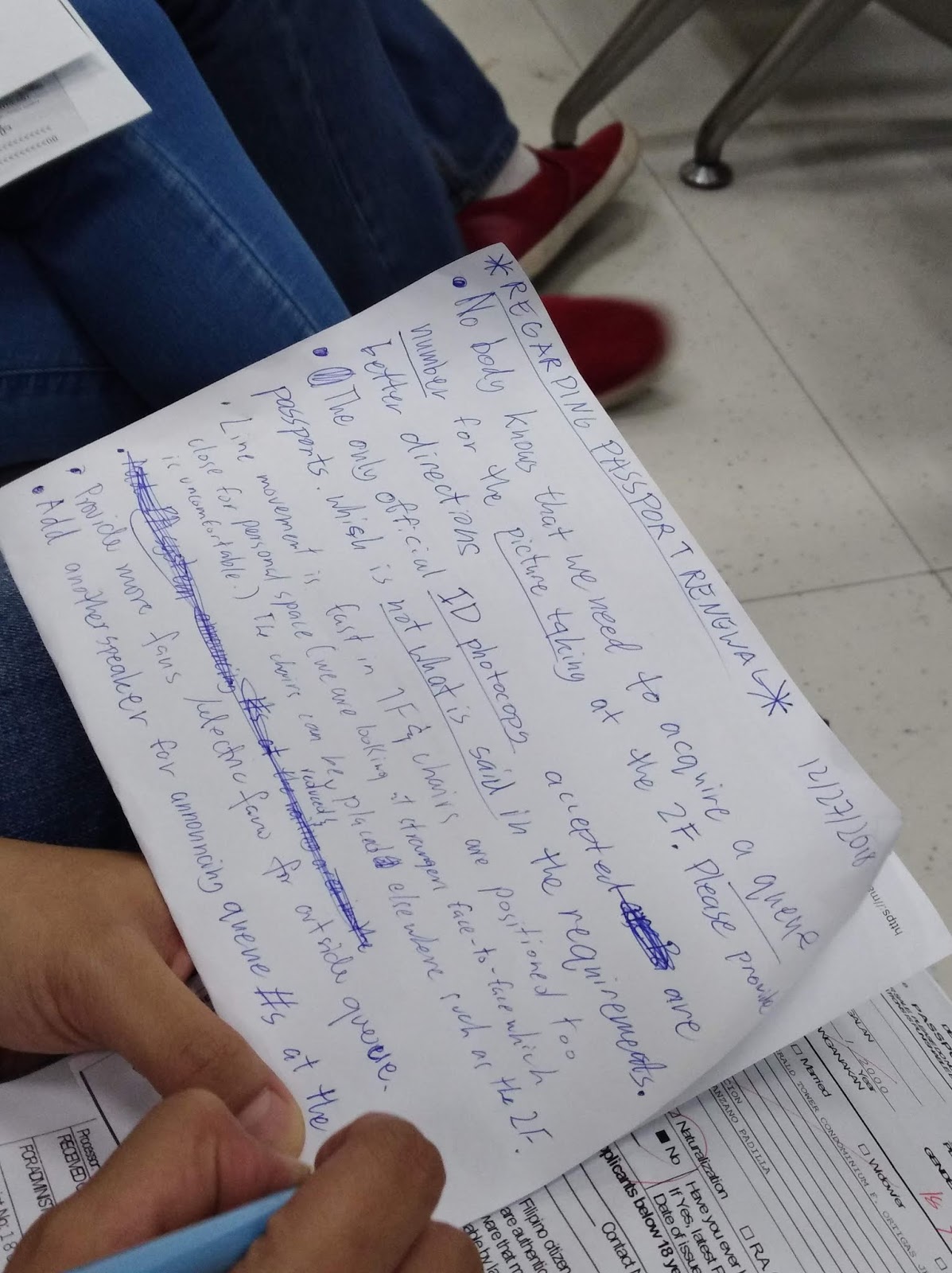
When you finally get to the counter to get served for your passport renewal, they'll punch a hole in your old passport to invalidate it. What this means for you in your long and arduous journey around the DFA complex is that you're 50% done with the process. Then they'll send you up to the 2nd floor so you can wait in line some more to get your picture taken. During your time up there, you'll see a complaint box. You'll be waiting in line for a while so you have plenty of time to think of all the ways the DFA could be serving its customers better.

Writing a complaint was exactly what we did. We made it as constructive as possible.
And I suppose that's all there is to bring to make the process much less infuriating. After you get your picture taken, you'll get a receipt with the date on when you can claim your new passport, then you're free to go home. We came prepared with all of the items I listed above out of sheer luck, and we left the DFA not completely bothered by how long it took.

As a bonus, here are some additional tips that will save you some hassle:


  • Bring a photocopy of your passport. Instructions aren't very clear. They say you can bring a photocopy of any government ID but once you get to the counter they'll ask you for a photocopy of your passport and they don't accept any alternatives. There's a photocopy machine in the building.
  • When you get to the 2nd floor, you need to get a queuing number. Instructions aren't very clear on this one. You can get it all the way from across the room. We wouldn't have known about this, but thankfully someone who's also in line for passport renewal informed us.

(This blog post didn't cover the documents you have to bring for the passport renewal. Is that what you were looking for? You can find that info and more here.)